Vibe coding is increasingly being hailed as the “holy grail” of application development, particularly in contexts where speed and rapid validation of ideas are critical. But is business software development truly entering a stage where simply describing your intent is enough to generate a complete, fully functional solution?
The development of dedicated business software has evolved in stages over the years. New approaches, tools, and operating models continue to reshape how systems are designed and delivered. However, such shifts rarely lead to the abrupt replacement of existing solutions. Instead, they typically involve a gradual change in priorities and an expansion of capabilities across both IT and business teams. We are witnessing a similar dynamic today with the growing popularity of vibe coding alongside mature low-code platforms.
We are witnessing a similar dynamic today with the growing popularity of vibe coding and mature low-code platforms. Rather than competing directly, these approaches address different needs and are increasingly complementing each other within modern development ecosystems.
According to Gartner analysts, by 2028 up to 40% of new business applications could be developed using AI-driven approaches such as vibe coding. The rapid rise of this trend is no coincidence. For many teams, it represents the long-sought “holy grail” of software development, as it directly addresses a critical market need: dramatically shortening the path from idea to working solution. Instead of preparing detailed specifications, managing extensive backlogs, and waiting through weeks of development cycles, users can describe their needs in natural language – and AI generates the corresponding code.
Vibe coding is an approach in which the user defines the intended outcome, and the model generates the corresponding code – often ready to run immediately. This enables quick validation of ideas and significantly accelerates the software development process. It is particularly effective in scenarios that prioritize speed, experimentation, and rapid iteration, allowing teams to “materialize” concepts and see them in action rather than relying solely on presentations or documentation. However, vibe coding is not designed as a comprehensive model for the long-term development and maintenance of business-critical systems. It does not eliminate the challenges that emerge in later stages of the software lifecycle – especially those related to security, governance, standardization, compliance, and long-term accountability for systems expected to operate reliably for years. This is precisely where low-code platforms naturally come into play.
Today, low-code is a proven and well-established approach to building systems that support business processes across many organizations. In the context of enterprise software development, it functions as a set of guardrails – intentionally limiting certain design choices in order to enhance predictability, security, and scalability. As a result, teams do not build systems from scratch each time, but instead operate within proven architectural frameworks and standardized components. In practice, this means:
Low-code does not compete with the speed of experimentation. Instead, it provides the structure needed to transform experimentation into stable, scalable systems.
One of the areas where the difference between low-code and vibe coding becomes particularly evident is security. In the vibe coding model, working code can be generated quickly, but critical aspects such as access control, data validation, secret management, and logging are not always embedded as foundational elements of the solution. As a result, responsibility for properly addressing these concerns often shifts to the user – who may not always have the expertise or governance framework required to ensure enterprise-grade security.
A low-code platform operates differently – it embeds security mechanisms by default and enforces their application at the configuration stage. Data access controls, user roles, event logging, and system integrations are implemented in a standardized manner, aligned with established best practices. A well-designed low-code environment is “secure by default” significantly simplifying compliance with internal security policies and organizational standards. For systems expected to operate reliably over many years, this distinction becomes fundamental.
If security is the first area where the differences between vibe coding and low-code become apparent, governance and compliance are the natural extensions of that discussion. As the volume of data, integrations, and interconnected systems continues to grow, so does the complexity of the IT environment – along with the organization’s responsibility for what is deployed into production. In this context, managing not only innovation but also control, accountability, and regulatory alignment becomes a critical strategic priority.
As long as a system remains in the experimental phase, these issues may appear secondary. However, the situation changes once the solution moves into a production environment and begins to support real business processes, users, and sensitive data. At that point, critical questions inevitably arise:
– ensuring a complete audit trail, robust version control, effective permission management, and secure rollback capabilities is not merely a matter of team convenience – it is an operational necessity and, in many cases, a regulatory requirement.
Mature low-code platforms designed for enterprise environments embed these mechanisms directly into their architecture. Separate environments, clearly defined roles, controlled deployment paths, and comprehensive change logging establish a structured and consistent system management model. As a result, the development and maintenance process remains transparent, auditable, and aligned with established organizational standards. This represents a practical implementation of the “secure by default” principle – where security and governance are integral to the platform’s design, rather than reactive measures introduced only after issues arise.
At the same time, simply labeling a solution as “low-code” does not automatically guarantee maturity. It is therefore essential to assess whether the platform used within the organization truly supports a structured governance model in practice. Ultimately, it is the way changes and permissions are managed that determines whether governance functions as a genuine control mechanism – or remains merely a concept without effective enforcement tools.
The differences between these approaches become particularly evident once a solution moves beyond the prototype stage and evolves into a system that must be maintained over time. In the vibe coding model, the primary focus is often on rapidly delivering compelling business functionalities. Only later do the less visible – yet critical – aspects come into play: deployment management, rollback mechanisms, environment handling, regression testing, and structured version control. These elements ultimately determine long-term stability and operational reliability. It is precisely in this area that low-code platforms introduce clear governance rules and structured control, ensuring that innovation can be sustained without compromising stability.
It is no coincidence that the concept of “shadow AI” is gaining traction – echoing the earlier challenges associated with “shadow IT.” The rapid expansion of vibe coding may result in the proliferation of uncontrolled micro-applications that effectively address specific, localized problems in the short term, but become difficult to monitor, maintain, and secure at scale. In this context, low-code does not constrain creativity; rather, it structures it within a framework that enables organizational growth without sacrificing control, transparency, or long-term stability.
The discussion around governance and compliance increasingly extends beyond purely procedural or operational considerations. It also raises a more fundamental question: who truly controls the technology on which the organization depends?
Many popular vibe coding solutions are built on technologies developed outside Europe – both in terms of AI models and the underlying computing infrastructure. This raises concerns not only about regulatory compliance, but also about resilience in an increasingly uncertain geopolitical landscape. In a world where economic tensions have become a persistent reality, dependence on critical components developed and maintained outside the EU is no longer purely a technical matter – it becomes a strategic consideration.
As a result, more and more organizations are evaluating not only the functionality of a solution, but also the origin of the underlying technology and the level of control maintained across the entire data processing chain. For companies operating in Europe, solutions developed and maintained within the EU – and ideally within the same country – are becoming increasingly significant. In this context, selecting a platform is no longer merely an IT decision. It becomes a strategic choice, directly linked to risk management, operational resilience, and the pursuit of long-term technological independence.
The debate over whether low-code still has a place is, in reality, a discussion about the level of organizational maturity. The core question is no longer, “How can we generate code quickly?” but rather, “How can we deliver business value quickly – and responsibly?”
Vibe coding significantly shortens the distance between an idea and the first version of a solution – but that is only the beginning of the journey. The real challenges emerge when the solution must operate at scale, integrate seamlessly with existing architecture, comply with security standards, and evolve sustainably over the years. This is where low-code enters the picture – not as an alternative to AI, but as a framework that structures and governs its use. In an era defined by generative speed, competitive advantage will not belong to those who produce the most code, but to those who can effectively manage its quality, consistency, and long-term maintainability. Technology is accelerating, yet responsibility for how it is applied remains firmly with the organization. For this reason, the debate about the relevance of low-code is not about trends or hype – it is about strategic choices that shape long-term stability and growth.
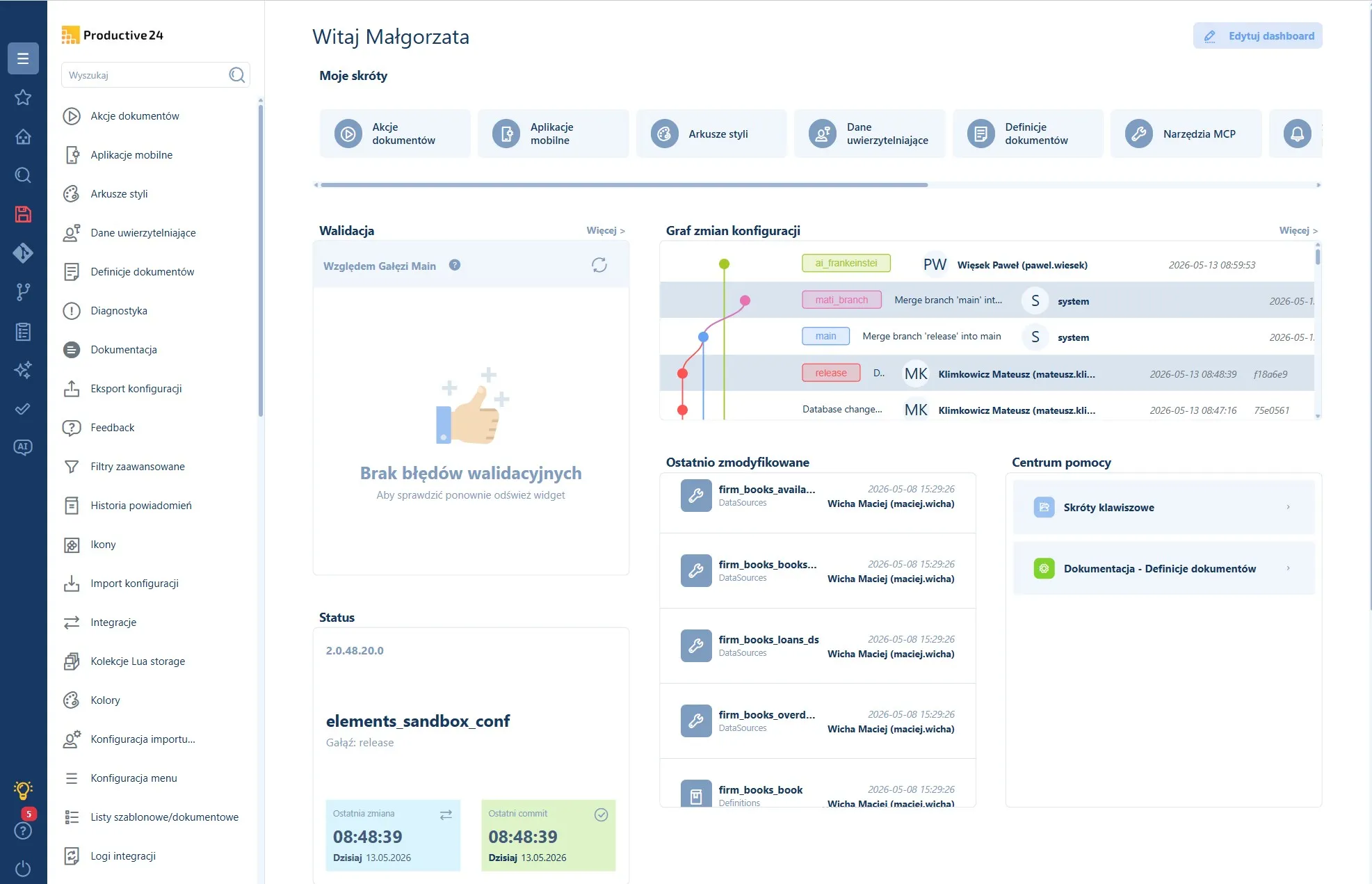
Productive24 is a low-code platform that enables the rapid development of secure, scalable, and multi-platform IT solutions – without the need to engage traditional programming resources. By leveraging low-code technology, business analysts can independently design and build complex applications, while artificial intelligence is seamlessly integrated into the platform’s architecture. With capabilities such as the built-in Workflow Agent Builder engine, AI becomes a fully embedded component of the solutions created within Productive24.
The platform also supports the development of MCP (Model Context Protocol) tools using a low-code approach. As a result, organizations can achieve more accurate and context-aware model responses, optimize LLM-related costs, and maintain full control over the scope of information made available to artificial intelligence. Through MCP, AI operates according to the same principles as a system user – accessing data strictly in line with assigned permissions, navigating the application environment, executing tasks, and making decisions within a defined role. All activities are governed by established security mechanisms, role-based access controls, and comprehensive auditability, ensuring full transparency and compliance.
Would you like to experience the new Productive24 AI in action? Start with a PoC or MVP. Thanks to ready-made components, low-code technology, and built-in AI capabilities, you can launch your first working solutions within just a few days – without lengthy implementation cycles or the need to involve a full development team. Our experts will support you in designing and executing a pilot tailored to your specific processes and business needs. It’s a fast, secure way to evaluate the real impact of AI before making a decision about scaling.
See Productive24 AI in Action!
to our newsletter and stay up to date with new publications on the blog.
Try it out at no risk!